|
|
|
ACTIVE
TRIPS REQUIRE MORE ADVANCE PLANNING 10 Adventure Travel Tips
from the Adventures in Travel Expo New York, NY: Gone are the
days when vacationers sought nothing more of the
outdoors than a comfortable chaise lounge at the
beach resort. The most recent survey completed by
the Travel Industry Association of America shows
that among U.S. travelers alone, 173 million
person-trips each year involve at least some
outdoor recreational activity. And while there are
as many definitions of "adventure travel" as there
are travelers seeking adventure, more and more
vacationers think of relaxation in terms of rock
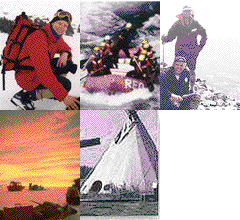
climbing, mountain biking, snorkeling, whitewater
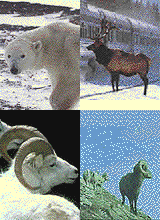
rafting, and close encounters with wildlife in its
natural habitat. How do you prepare for these new
encounters, these emerging
activities? As adventure travelers
continue to explore new vacation territory, both in
the U.S. and abroad, they have to change the way
they prepare for their vacations and adventures, as
well. The organizers of the Adventure Travel Expo,
which will be held in NYC January 9-11, 2004 at the
Jacob Javits Center, offer these tips for safe and
happy adventure travels: * Do your homework.
Bookstores and websites offer a wealth of resources
about your destination, its attractions, the food
and facilities there, and cultural considerations
you'll want to bear in mind to make the most of
your experience and your contact with the local
people. Start with www.lonelyplanet.com,
www.activetravel.about.com , www.roughguides.com
and www.maps.com for a long list of links and
resources to start your planning. If you're
planning on doing any purchasing when you're in
foreign locales, you'll want to read U.S. Custom's
"Know Before You Go for more information on
products that cannot be imported to the
U.S. * See your doctor.
Certain vaccines and preventive medications are
recommended and in some cases required for travel
to some remote locations. Your own medical history
and conditions may also affect what precautions and
preparations are advisable for you; consult with
your doctor to determine what you need to do to
stay healthy on your trip. If you're visiting a
remote location, obtain a list of the best medical
facilities in the region and consider bringing a
supply of emergency supplies with you in the event
that the sterility of local medical supplies is
uncertain. Even a local camping trip can pose risks
you can easily eliminate by, for example, making
sure your tetanus inoculation is current. Keep tabs
on your health after your return, too, and see your
doctor promptly to diagnose and treat any
post-travel symptoms of illness. For more
information to share with your doctor during your
discussion,check out www.cdc.gov.travel for U.S.
government health advisory information around the
world or travelhealth.net, for information on
specific travel related health issues. * Be prepared for changes in
climate and environment. Travel is tiring
under any circumstances. Throw a change in altitude
into the mix and you may not be able to participate
in your planned activities as immediately or as
fully as you had hoped. Take it easy, take it slow,
and try to arrive a day or two before you begin
strenuous physical activity so your body has time
to adjust to its new surroundings. Although most
people can go to 8,000 feet from sea level without
a negative effect, anything above that classifies
as a higher risk, and some people are more
susceptible than others to altitude and weather
changes. Acclimatizing for a day or two helps
you find out! * Get in shape. Peak
physical performance is optimal for all strenuous
activities, and particularly important for those
that involve heights or depths like mountain
climbing, treks in high altitudes, or diving.
Several months before taking a high adventure trip,
work with your doctor to develop a physical
exercise program designed to get you in the best
condition for the activities you'll be undertaking.
You can do this even in an urban setting by stair
climbing, walking, and weight lifting. * Protect yourself from the
elements. When you're outdoors for long periods of
time, a wide-brimmed hat and a high-SPF,
non-PABA-based sunscreen is essential - - even more
so if you're in a tropical or sub-tropical location
or at an elevated altitude. Closed shoes can
literally be a lifesaver by protecting your feet
from unfriendly parasites; in some locations you're
best off leaving your sandals at home. Long pants
and sleeves may be your best bet in certain buggy
climes and don't forget the DEET-based insect
repellent! * Avoid alcohol. Alcohol
dehydrates the body, and you'll need to keep your
body fully hydrated for strenuous activity. While
the tendency on any vacation is to have a few
cocktails, you'll want to abstain if you're
planning high-energy physical activity. Bottled
water is the drink du jour for smart adventure
travelers! * Consider travel
insurance. If you'll be in a remote location,
at home or abroad, think about investing in a
travel insurance plan that can simplify and
minimize the expense of getting home in the event
of an injury or other emergency. Check out
www.insuremytrip.com if you don't have a resource
to explore this option. * Pack carefully. Think not
only about your first aid kit and drugstore
supplies, but also about items you may have
difficulty obtaining once you're out on safari or
have ascended to 1000 feet on that mountain. That's
no time to realize you need fresh batteries, a rain
poncho or a few more rolls of film. It's not a bad
idea to keep a spare toothbrush on hand,
either. Just as important: pack no more
than you can carry....most porters are not working
in the rain forests of the Amazon. * Know the communications
situation. When traveling in remote locations, you
likely won't find a pay phone. Before you go, learn
what communications links will be available to you,
and determine whether you'd be able to acquire a
cell phone at the destination or whether you need
to investigate satellite phones in advance. These
hi-tech phones have come down in price in recent
years. www.worldcell.com offers a wide range of
options such as renting satellite phones,
international cell phones and
more. * Practice the adventure
travel credo. "Take nothing but
photographs. Leave nothing but footprints."
The great coral reefs, waterways, mountains
and rain forests can only be as beautiful for
travelers that follow if we all plan to remove our
trash, look but not touch, and walk, don't
drive! The Adventures in Travel
Expo will appeal to travel enthusiasts who not only
want to visit a destination, but to experience it
from an activity, cultural or spiritual standpoint.
Adventure travel encompasses a wide range of
activities - everything from soft adventure such as
walking tours, bird watching, cruising, and
camping, to hard adventures like white water
rafting, wilderness expeditions, extreme skiing and
arduous treks. The Expo, sponsored by New York
media giants like The New York Post and 1010 WINS
radio, as well as others like National Geographic
Adventure, will present a unique opportunities for
consumers to find information about all aspects of
adventure travel under one roof. We join with
industry leaders such as the Rainforest Alliance in
promoting responsible adventure
sports. For more information about
the Adventures in Travel Expo, please contact Jim
Cohen at (203) 878-2577 x 22 or visit
www.adventureexpo.com. |
|