|
|
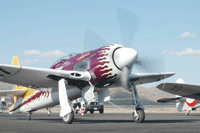
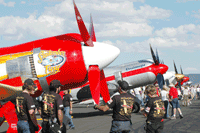
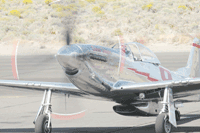
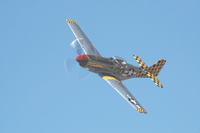
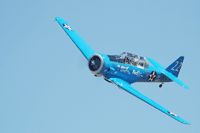
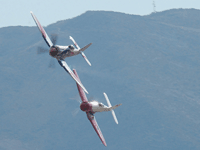
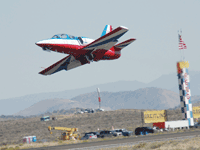
Reno National Championship Air Races and Air Show 2007 "Salute to Champions" Photos and story by Ed Anderson, Vancouver, BC, Canada Ideal summer weather held for the 44th edition of the National Championship Air Races at Reno, Nevada September 12-16. This year's event themed "Salute to Champions" drew a full slate of race competitors, and a first-rate complement of air show performers. All told, some 130 race planes, in six categories, qualified for competitive heat racing, based on timed lap speeds. Official racing and air show performances kicked off on Thursday, September 12. Air racing, which happens now only at Reno, Nevada, is in the overall colourful, exciting, and competitive, but fraught with hazards, and high risk. Welcome to the World's Fastest Motorsport. The sometimes called 'little guys' are the International Formula 1 Class (IF-1). Built and powered pursuant to rigid technical specifications, Cassutts and other mini-breeds fly a 3.187-mile oval course off a ground start, set from qualifying positions, can clip along at upwards of 250-mph. In a similar vein, small aerobatic biplanes such as the Pitts Special make up the Biplane Class. These wee 'Bipes' also use a ground start onto the same pylon course as the F-1, and can, likewise, attain speeds over 200-mph. The Sport Class, introduced in 1998, comprises high performance production kit-built aircraft, which includes the likes of Lancair, Glasair, Questair Venture, and NXT, jumps speed to the next level, often surpassing the 350-mph mark, from an air start into a rounded 7.0860-mile pylon course. In 1968 the concept of match-racing stock aircraft was initiated at Reno with the North American AT-6 'Texan' advanced trainer type, which included the U.S. Navy version SNJ (J-Bird), and the Canadian-built Harvard. Similar in airframe structure and engine power (P&W R-1340-AN-1 air-cooled radial) these aircraft came to be the T-6 Class. These stock competitors that consistently reach qualifying speeds over 200 mph, also get an air start into a 5.0646 mile course. A few years back, quiet jets were invited to participate in a class-match racing demonstration. Open only to the standard Czech-built Aerovodochody L-39 "Albatros" non-afterburning jets, the Jet Class this year was expanded to include other similar jets having less than 15 degree of wing sweep. Well it was interesting. The appearance of a Lockheed T-33, minus wing-tip tanks, a couple of Aero L-29 "Delphins", and a husky Rockwell T-2B "Buckeye", #00, owned and flown by Dr. Richard Sugden, the easy Gold winner, posted a new race record for jets of over 489-mph, certainly did give us variety. An expected Fouga Magister did not race. The Unlimited Class, open to any piston-driven aircraft with an empty weight greater than 4,500 pounds, has no limitations as to engine power and structure. With few exceptions this "Big Iron" group has mostly attracted stock or modified WW II designed fighters. This year's participants included mostly P-51 Mustangs and Hawker Furies, four F8F Bearcats, three Russian Yaks, an F2G Super Corsair, an F7F Tigercat, and an FM-2 Wildcat, from which those that qualified would advance to compete in race heats of Bronze, Silver, and Gold categories. Gold Race Sunday produced a clear blue, sun filled sky and little wind. Perfect for racing aircraft. Prefacing the Unlimited Championship face-off in late afternoon, the outcomes of other Championship races had already been settled. Formula 1 class winner was David Hoover of Foster City, CA in #11 Endeavor, with an average course speed of 245.669-mph. Chris Ferguson of Springdale, AR, flying #13 Miss Gianna took first place in the Biplane class with a speed of 233.470-mph. Pete Zaccagnino of Flemington, NJ captured Sport Gold with a Lancair IV, #28 at 301.616-mph. Super Sport winner was none other than Jon Sharp, of Mojave, CA flying his 3X Nemesis to a new course speed record of 385.65-mph. The always colourful and keenly competitive T-6 Class produced a fresh winner - Dennis Buehn of Carson City, NV, with #43, Midnight Miss III, narrowly nipping out Nick Macy, and posting a winning speed of 234.939-mph. The always thrilling final Unlimited race, again, did not disappoint in 2007. Nine modified muscle planes airborne, collected into formation behind the T-33 jet pace-plane, to be released from a determined start position into the so-called "chute" over pylon 2. Here, every pilot pushes hard for position into the 8.4803 mile, 9 pylon, race course. FLY LOW, GO FAST, TURN LEFT for 8 laps, at least for those who don't break. This is the Unlimited Breitling Gold, where in the "Valley of Speed", approaching pylons 7 & 8, some of the "Big Iron" racers can touch, even surpass the 500-mph mark. This year, to everyone's surprise, #77, "Rare Bear", with John Penny of Evergreen, CO driving, held together capturing first place with an average course speed of 478.394-mph. The swiftest Sea Fury ever, #232 "September Fury" piloted by Mike Brown, pulled up and out on lap 7 due to a troubled engine. Bob Button in Voodoo, #5, the only P-51 Mustang left in the hunt, was out on lap 2. Both injured race planes landed safely. As the fickle finger of fate would have it, "Dreadnought" the big '4360' Sea Fury flown by Matt Jackson, passing the finish flag in second spot, was disqualified for cutting the East Deadline. Consequently, Sherman Smoot of Templeton, CA in the little Yak 11, #86, "Czech Mate" slipped into second place, and Stewart Dawson of Celina, TX, in a Sea Fury #105 "Spirit of Texas" grabbed third spot. Just a heck-of-a-race!! Gate attendance for 2007 apparently was expected to surpass last year's total of 208,000. Next year's program is set for September 10-14, at Reno Stead Field, NV. Further details of this year's events can be found at www.airrace.org
Story and Photos By Ed Anderson |